


As a supplier of nylon tubes, I understand the critical importance of accurately measuring the length of these tubes. Whether you're using 3 8 Nylon Tubing for industrial applications or High Pressure Fog Machine System Nylon Tube for specialized fogging systems, precise length measurement is essential for ensuring proper fit, functionality, and cost - effectiveness. In this blog post, I'll share some effective methods and best practices for measuring the length of nylon tubes accurately.
Understanding the Basics of Nylon Tube Measurement
Before we dive into the measurement techniques, it's important to understand some basic concepts related to nylon tube measurement. Nylon tubes come in various diameters, wall thicknesses, and lengths. The length of a nylon tube is typically measured from one end to the other in a straight line, excluding any fittings or connectors.
The accuracy of your measurement can be affected by several factors, including the flexibility of the nylon tube, the presence of bends or curves, and the measuring tool you use. Therefore, it's crucial to choose the right method and tool for the specific application.
Measuring Tools
Tape Measure
One of the most common and straightforward tools for measuring the length of a nylon tube is a tape measure. Tape measures are readily available, easy to use, and can provide reasonably accurate measurements for most applications.
To use a tape measure, simply extend it along the length of the tube, making sure it follows the tube's contour as closely as possible. If the tube has bends or curves, try to straighten it out gently without stretching it. This can be done by holding the tube at both ends and applying a slight tension.
However, tape measures have some limitations. They may not be very accurate for measuring long tubes, as it can be difficult to keep the tape measure straight and aligned. Also, the flexibility of the tape measure itself can introduce some errors, especially when measuring tubes with irregular shapes.
Ruler
A ruler is another simple tool that can be used for measuring shorter nylon tubes. Rulers are more rigid than tape measures, which can provide more accurate measurements for straight tubes.
To measure a nylon tube with a ruler, place the ruler alongside the tube and align one end of the tube with the zero mark on the ruler. Read the measurement at the other end of the tube. Make sure the ruler is in contact with the tube throughout the measurement to ensure accuracy.
Like tape measures, rulers are not suitable for measuring long or curved tubes. They are best used for tubes that are relatively short and straight.
Laser Distance Meter
For more accurate and efficient measurement of long or hard - to - reach nylon tubes, a laser distance meter can be a great option. Laser distance meters use laser technology to measure distances accurately and quickly.
To use a laser distance meter, point the laser at one end of the tube and then at the other end. The meter will display the distance between the two points, which is the length of the tube. Laser distance meters are very accurate, even for long distances, and can be used in various environments.
However, laser distance meters are more expensive than tape measures and rulers. They also require a clear line of sight between the two measurement points, which may be a limitation in some applications.
Measuring Techniques
Straight Tubes
Measuring straight nylon tubes is relatively easy. As mentioned earlier, you can use a tape measure, ruler, or laser distance meter depending on the length of the tube.
When using a tape measure or ruler, make sure the tube is laid out straight on a flat surface. If the tube is coiled, uncoil it carefully to avoid kinks or bends. For long straight tubes, it may be helpful to have an assistant hold one end of the tube while you measure from the other end.
Curved or Bent Tubes
Measuring curved or bent nylon tubes requires a different approach. One method is to use a flexible measuring tape. Flexible measuring tapes can follow the contour of the tube more easily than rigid rulers.

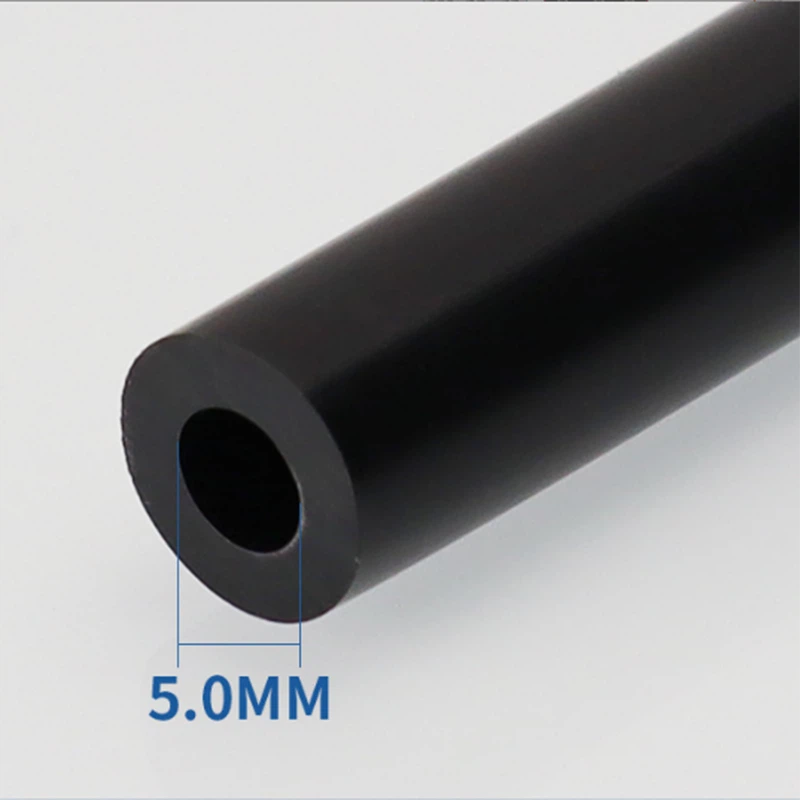
Another method is to use a string or a wire. First, place the string or wire along the length of the tube, following its curve. Mark the points on the string or wire that correspond to the two ends of the tube. Then, straighten the string or wire and measure its length using a tape measure or ruler.
For more complex curves, you may need to break the tube into smaller straight segments and measure each segment separately. Then, add up the lengths of all the segments to get the total length of the tube.
Measuring Coiled Tubes
Measuring coiled nylon tubes can be challenging, as the tube is not in a straight line. One way to measure a coiled tube is to uncoil it and measure it as a straight tube, as described above. However, this may not be practical for very long or tightly coiled tubes.
Another method is to measure the diameter of the coil and the number of turns. The length of the tube can then be calculated using the formula for the circumference of a circle ((C = \pi d), where (d) is the diameter of the coil) and multiplying it by the number of turns.
However, this method assumes that the coil is perfectly circular and that the turns are evenly spaced. In reality, there may be some variations, which can introduce some errors in the measurement.
Best Practices for Accurate Measurement
Avoid Stretching the Tube
When measuring a nylon tube, it's important to avoid stretching it. Nylon tubes are flexible and can be stretched easily, which can lead to inaccurate measurements. To prevent stretching, handle the tube gently and apply only a slight tension when straightening it.
Take Multiple Measurements
To ensure accuracy, it's a good idea to take multiple measurements of the same tube. This can help to identify any errors or inconsistencies in the measurement. Take the average of the multiple measurements to get a more accurate result.
Check the Measuring Tool
Before using a measuring tool, make sure it is in good condition and calibrated correctly. A damaged or uncalibrated tool can lead to inaccurate measurements. For example, a tape measure with a worn - out end or a ruler with a bent edge may not provide accurate readings.
Conclusion
Accurately measuring the length of a nylon tube is crucial for ensuring proper fit and functionality in various applications. By choosing the right measuring tool and technique, and following the best practices outlined in this blog post, you can achieve accurate measurements and avoid costly mistakes.
If you have any questions about measuring nylon tubes or are interested in purchasing high - quality nylon tubes for your project, please feel free to contact us for more information and to start a procurement discussion. We are dedicated to providing our customers with the best products and services.
References
- "Measurement Techniques in Engineering", John Wiley & Sons
- "Materials Science and Engineering: An Introduction", William D. Callister Jr. and David G. Rethwisch


